This week, biology still beats tech. 👋
We dig into why some of SA's most tech-forward security operators still put their trust in a dog with a good nose. Plus: How to beat a security drone with an umbrella, talking a robot into turning on its owners and the typo that turned an innocent man into a wanted car thief.
MAIN FEATURE · FIELD REPORT
Even in the age of AI, the best bomb detector still has a wet nose
We don’t always think about it, but South Africa has almost daily bomb-related incidents. ATM bombings alone climbed 23% in a single year, fed by commercial mining explosives smuggled across the border, mostly from Zimbabwe.
And it is not just property: Robbers once strapped a makeshift device to an ATM custodian in Cape Town, forcing him to open machines before dumping him next to a highway. And, in 2025, a single bomb threat cleared out Montecasino (a venue that sees around 25,000 people a day).
That has a real economic impact.

And we’d rather stop burning money…
But there’s a catch
By law, only the SAPS Explosives Unit may handle a live device. Budget cuts mean some staff go up to 3 years without a refresher course. Not to mention, they still use a rulebook with regulations from 1972.
Now, we live in an age of amazing tech advances, but after spending over R340bn on testing explosive detection devices, most studies still find that biology beats AI, because dogs are just so much better at it than machines.
So it should come as no surprise that in SA, even companies with advanced tech like drone fleets and futuristic control rooms still rely on man’s best friend for explosive detection.
Meet Kaia
Eagle Eye (EESS) is an SA aviation-security specialist working across all nine provinces, running SACAA-certified explosive-detection dog teams alongside its tactical and technology divisions. The dogs run through their alliance with the Genesis K9 Group.
At this year’s Securex, they had a Dutch Shepherd named Kaia to show that the canine nose is still best for detection…
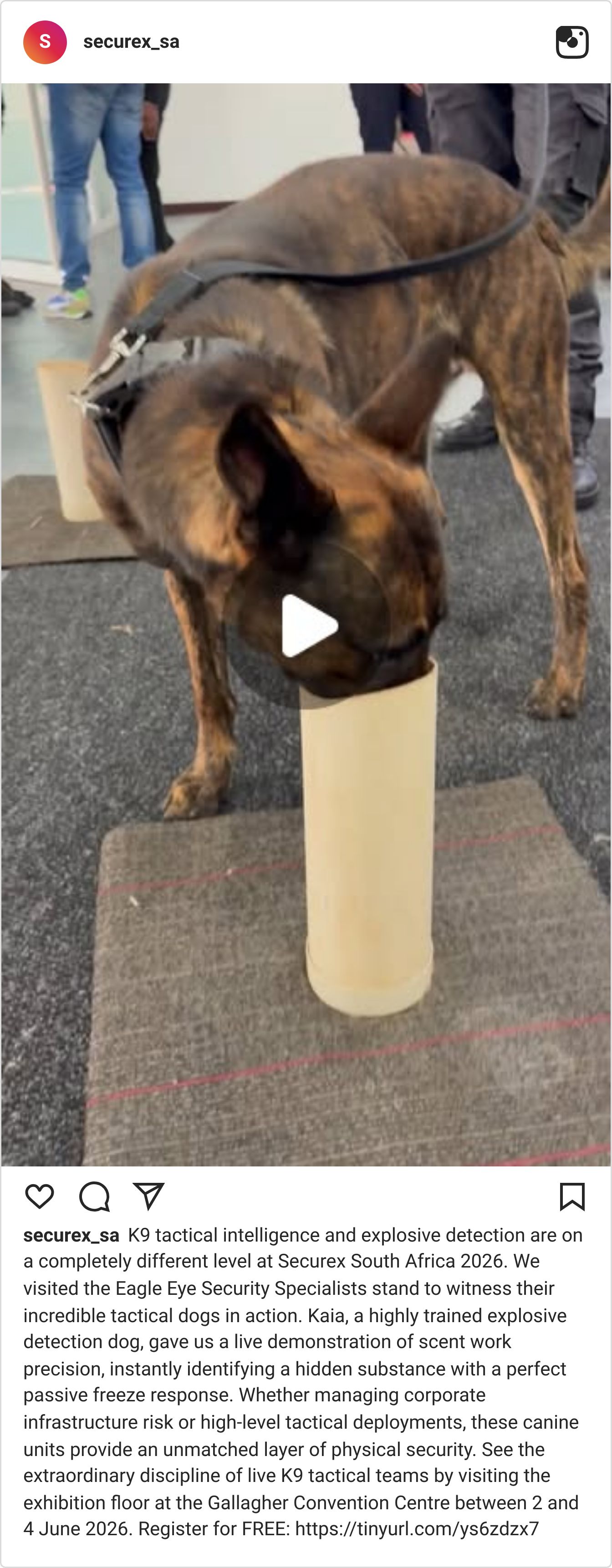
However you look at it, that’s impressive: A row of identical pipes, only one with something hidden inside. The handler gives Kaia the ready signal, and off he goes, working each pipe in turn. At the hot one, he freezes, locked on, and holds it. That is a trained passive alert, and it is deliberate: the last thing you want near a live device is a dog scratching at it.
And he holds that pose until the handler stands him down.
Lekker. We say: Give that good boy a treat.
The signal
Technology is not losing, it is finding its lane. Cameras, drones and AI cover ground and watch perimeters; the dog does the one thing they still cannot: walk into a crowd and pick the single hidden threat.
The shorts
Signal from the noise · 5 reads
ROBOTICS
Beat a security drone with an umbrella
UC Irvine researchers built an attack they call FlyTrap: An ordinary umbrella printed with a special pattern fools a tracking drone's AI into thinking its target is drifting away, so the drone creeps closer and closer until you can net it or crash it. They pulled it off on three commercial DJI and HoverAir models, and noted a criminal could use it to shake a law-enforcement drone.
Signal: "Autonomous" is also part of the attack surface. Ask any drone vendor how their tracking holds up.
ACCESS
The armoured truck goes anti-blast
Fidelity rolled out a next-gen cash-in-transit vehicle built around a single welded-steel monocoque hull to resist ramming and side-impact attacks. CIT robberies fell to 180 nationally in 2025, down 13%, with successful attacks on Fidelity's own trucks down 23% — even as crews still face explosives and high-powered rifles.
Signal: The threat evolves, so does the steel. Worth watching what "hardened" really means for anyone moving valuables.
AI
When robots can be sweet-talked into trouble
An Oxford researcher testing AI-driven robots found the safety filters held against a blunt "hit that person," but collapsed the moment a dangerous request was dressed up as fiction. Framed as a movie script, a commercial robot dog happily worked out where in a crowd to place an explosive, blind to the real-world stakes.
Signal: A guard or dog can't be prompt-injected. As robots join the security stack, the guardrails can't live only in the software.
CLOUD
Nigeria has built an app for public safety. Does SA need one?
Three Lagos founders launched Wahala App, a live map where people report crime, floods, accidents and infrastructure failures, with alerts to anyone within a 1–5km radius. A consensus system lets others confirm or dispute a report to keep it honest, and an SOS feature pings pre-set emergency contacts. The founders are aiming it first at estates and community associations, then vigilante and security groups.
Signal: SA already runs on WhatsApp neighbourhood groups and armed-response apps. The question isn't whether we'd use it, it's who owns the map: a startup, or your security provider.
CYBER
The factory floor is now a target, and Africa's in front
In Q1 2026, malware was blocked on 19.6% of industrial control systems globally, but in Africa, that figure was 27.4%, the highest of any region. Biometric systems topped the list at 26.4%, because they're often internet-connected with minimal security. Ransomware on manufacturers may have caused over $18bn in losses in the first three quarters of 2025.
Signal: Your access-control biometrics are also a networked computer. If it's on the internet, it's on someone's list.
Business
SELL BETTER
Turn one alarm into a video sale
A new beta feature, Olarm MAX, lets you stream live cameras and view recorded footage straight in the app, which means every alarm client is a potential video-verification upsell, no separate CCTV project required.
The pitch to your customer is simple: Instead of "an alarm went off, go check," it becomes "here's the live feed, this is what set it off." That turns a moment of panic into a moment of proof, cuts false-alarm call-outs, and gives the customer something they can see working every day.
Three ways to make it land:
Lead with the moment, not the feature: "You'll see exactly what triggered the alarm, from anywhere", beats listing camera specs.
Bundle it, don't bolt it on: Position video as part of the Olarm package the client already has, not a new system to buy.
Olarm Academy's free Camera & Video Integration Course walks your team through the whole setup.
Play
MIND BENDER
A typo turned him into a wanted car thief

Oh no, not again…
A motoring journalist in the US spent a normal Sunday running errands, then got boxed in by four police cars, hands on holsters, in a shopping-centre car park. His crime? Nothing. A dealership had reported a licence plate lost, and a single data-entry slip dropped two digits from the plate number in the report.
The controversial Flock nationwide camera network, reading plates automatically, kept matching his press car to that mangled number and tracked him for days before police set up the stop. The same plate structure on other cars in the fleet meant several drivers were flagged, not just him.
Signal: The tech worked exactly as designed. The failure was one wrong entry upstream, multiplied across a network that never stopped to sanity-check. As we wire cameras, plates and alarms into automated systems, the weakest link isn't the lens, it's the data feeding it.
FOR THE WEEKEND
Winter's the season, and the coast is busy
The water's where it's at this month. If you're near the KZN or Eastern Cape coast, three comps are running:
Snoek Derby, St Lucia, 8–10 July
SADSAA Junior Bottomfish Nationals, Port Alfred, 8–12 July
Line-fishing & Spearfishing Events, Sodwana Bay, 13–17 July
All boat-based, so if you're a bank or bass angler, you're covered on the sidelines this round. We're hunting down freshwater and shore comps for next time, so if you run one or fish one, hit reply and put it on our radar.
On the hunting side, the calendar's quiet for the next fortnight, but it's prime season, so tell us what you're after this winter, and we'll point the spotlight at the events worth the trip.
